In this world, the Mother of God had, from an early age, from infancy, an unusual love for God.
Given over, as she had been, to the Holy of Holies, there, she not only prayed, but was also taught the law and the prophets by the priests of the temple.
As she prayed in the temple, two things happened…
On account of the fervency of her prayer and its union with the type of heart that the Virgin possessed, which is always the reason for this kind of prayer, she sensed her oneness with the entire race of humanity in her heart.
She recognized/knew God too, but she also recognized her oneness with the entire race of humanity.
And that was when her ambassadorship for all people began, even whilst she was still within the Holy of Holies.
And because she had acquired that divine state in which the will of God is holy and perfect, that state had been established within her (that is, it dwelt within her) as the sole law of her existence.
But, what is the will of God?
The will of God is one, on earth as it is in heaven. “Thy will be done, on earth as it is in heaven” (Matt. 6:10).
What is this will of God?
It is what the Lord said when he came into the world: “I have come to do thy will, O God” (Heb. 10:7).
In other words, the salvation of the world is that “all be saved”(cf. 1 Tim. 2:4); that is the will of God.
It is also why the Holy Virgin, who had sensed that widening of her heart, and who had given herself over to the will of God, had prayed for the salvation of the whole world.
In that fervor of her prayer, she read the Prophet Isaiah.There, she came to the passage that says, “Behold, the virgin shall conceive and bear a Son, and shall call His name Immanuel” (Is. 7:14)
All that which we read at Christmas.
And her mind could not proceed any further.
Her spirit stuck to that verse and her prayer changed, and she began to pray, “God of my Fathers, make me worthy to be the servant, or handmaid, of this woman who will give birth to Emmanuel”.
And upon the warmth of that humble prayer, the Archangel appeared and said, “Not the handmaid, but the very mother of Emmanuel.”
“Hail, O favored one, the Lord is with you”(Luke 1:28).
And that makes sense! God’s gifts are not bestowed so indiscriminately. “
A lily has fallen …” as Westerners say, that’s what happens… It is not so.
Analogous with one’s state, if he has a state that corresponds to the Spirit of God, which is compatible with the spirit of humility of God, then the gifts will come.
And the Virgin, who had the state most compatible to the Spirit of God, received the archangel’s salutation and the promise that she would give birth to Emmanuel, the Savior of the world.
And indeed, the Holy Virgin was not naive. For, one does not need to mix with the passions and impurities of the world to know what is happening in the world.
One who has been assimilated into the Spirit of God in a way that is without passions and above and beyond the vain world knows everything.
His spirit is “like a lightning bolt flashing across a meter of earth”, as Elder (now Saint) Sophronios used to say.
Thus, assimilated into the Spirit of God, the Holy Virgin thoroughly knew the mystery of God in all its depth, as well as human proceedings.
To the Archangel she said, “How shall this be, since I have no husband?”
And the angel said to her, “The Holy Spirit will come upon you, and the power of the Most High will overshadow you” (Luke 1: 34-35).
And then the Holy Virgin responds, “Let it be to me according to your word” (Luke 1:38).
And at that moment, she conceives the Son of God, the Word of God.
In other words, there is an orderliness in this mystery.
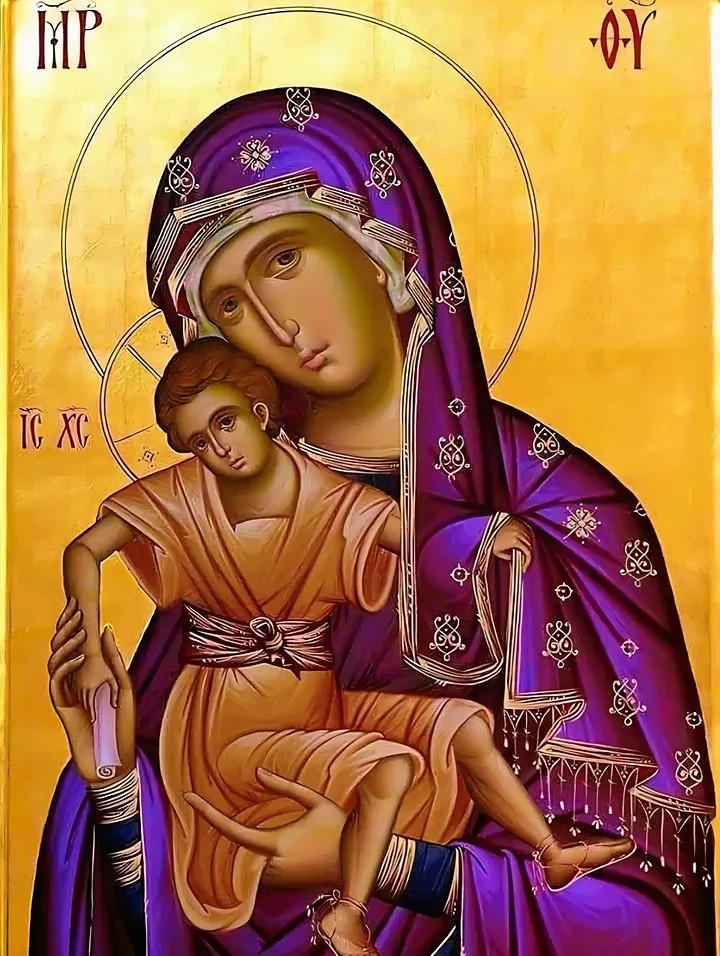
Thus, the Blessed Virgin received the unique grace of divine motherhood to become the Mother of God.
And afterwards, no matter how much grace one receives, they still remain human.
She ran to Saint Elizabeth, from whom she received the validation of what had taken place within her, which the Holy Virgin already knew.
As soon as Elizabeth saw her, and as soon as the voice of the Holy Virgin pronounced Elizabeth’s name, the Forerunner leaped in the belly of Saint Elizabeth in a prophetic way.
And Saint Elizabeth then places the seal on the event that had taken place within the Virgin Mary, for she said, “And why is this granted me, that the mother of my Lord should come to me?” (Luke 1:43).
And she stayed with Saint Elizabeth for three months, or so that the Holy Virgin would live with that grace from the Annunciation, and afterwards, she “returned to her home” (Luke 1:56), as we had heard in the Gospel today.
Thus, the Holy Virgin remained, without precedent, within the grace she had received from God, and within the synergy she had with God.
But, you know, when she had received that grace and had been validated by Saint Elizabeth, she then spoke that one time in order to thank God, the Benefactor.
The Holy Virgin did not speak; she had no reason to. Why?
It was because she had already given us the greatest Word, that of the Son and Word of God; she had given birth to The Word.
After that, what word could she say, having brought the greatest Word, God, the Second Person of the Holy Trinity, into this world? She had no other words for that, and with her silence, she held that grace within her heart.
Thus, many say that the Holy Virgin does not speak to us.
She speaks this one time, and from what she says, we see that there is but one mystery: “He has regarded the low estate of his handmaiden” (Luke 1:48).
That is, she did not say, “Look at this; all those years of prayers I had said in my home, the home of God, and all that asceticism I had done, all of the time I had been withdrawn from the world, all of it is why I have received this as a reward.” She did not talk about that.
“He has regarded the low estate of his handmaiden”, in other words, she spoke of her profound sense of unworthiness at becoming the mother of the Holy and Heavenly God!
Discover more from nous
Subscribe to get the latest posts sent to your email.


Leave a Reply